Friday, October 5, 2018

Conflict of interest: VC’s investment in rival start-ups


Deal 1: Mohr Davidow (VC firm) had investment in Navigenics as well as 23andMe.
Deal 2: Andreesen Horowitz(VC firm) had investment in photo-sharing company Instagram as well as Picplz.
Deal 3: Softbank (VC firm) had investment in Snapdeal as well as Flipkart.
Deal 4: Softbank (VC firm) has investment in Ola (india), Uber(US), Grab(SouthAsia) as well as DidiChuxing (China).

What is common to the above deals? Well, same VC firm has invested in two or more direct rival start-ups. Last few years have witnessed, increasing number of such deals wherein VCs have invested in rival start-ups. This observation has hit me hard as I started thinking how does this deal impact the key stakeholders such as start-up founders, Regulatory bodies, the core market in which start-ups are fighting and of course VCs.
Let us briefly discuss how this may create an impact on various stakeholders;
For VCs: Head I win, Tail you loose! : One of the most important stakeholders in the above-mentioned scenario is VCs. For VCs investing in rival start-ups may be trendy now as bigger VCs are increasing placing these kind of bets. One obvious reason identified after interacting with a couple of VC advisors, is VCs are also looking towards reducing the risk of their bet going in vain. (call it “risk mitigation strategy”) It is like when there are few sizzling start-ups which are look-a-like in the same market & when you have no clue which one is going to be the next blockbuster just invest in all of it or majority of it so whichever is going to go up eventually you are more assured that it will make money for you!

For Start-ups: “Money Trap?” :For most of the start-ups, attracting the VC funding may look like the holy grail. But a brilliant research article by Pahnke, McDonald, Wang and Hallen (2014) published in Academy of Management Journal found that investment of same VCs in rival start-ups may impede the innovation at the start-ups and also there is opportunity and motivation for VC to leak competitive important information to other rivals in which same VC is invested. When VC is invested in rival start-up firms it may so happen that VC may force two rivals to merge or acquire as SoftBank(VC) being investor tried to do in snapdeal with flipkart and Uber with Ola in the Indian market. Irrespective of what start-up founders & core team believed or dreamt about, forced merger/acquisition may happen to the whims and fancies of some VCs. Like Uber sold it’s SouthEast Asian business to Grab.(another rival funded by Softbank) Time is ripe that start-ups do certain check-list before going after VC’s money.
Such as 1. VC background checks if it has a considerable investment in another rival start-up(s), 2. The inclusion of certain clauses in ‘term-sheet and then into a definitive agreement which is legally binding agreement, which restricts VC to some capacity to invest in other rival start-ups or restricting access to competitive and confidential information (trade secrets) if VC is invested/or planning to invest in a rival start-up. For a start-up, mad rush after VC funding without doing proper background checks on VC may create more problems than solutions. Many angels & VCs never indulge in such activities of investing in rival start-ups but it is better for a start-up to act smartly!

For regulatory bodies: “Perplexed & lost”: Imagine you have huge war-chest (money) which you use to invest considerably in two majors competing start-ups. Since both start-ups are losing money big time in order to retain and increase customers by giving away deep discounts or providing unbelievable promo offers at throw away price, eventually you as a key investor decide to merge both entities and create one big giant. Now the merged entity will bleed less (lower burn rate) due to no significant competition. Here, an act of VC to safeguard their own interest by trying to force two competing start-ups to merge is directly impacting the dynamics of the market. Role of regulatory bodies (Like competition commission of India) which are enforcing anti-trust laws becomes crucial for maintaining the fair competition in the market. Unfortunately, many times such bodies do too little and too late. Regulatory bodies have to remain very vigilant and action-oriented when many direct competitors in the same market are backed by the same set of investors.


Thursday, July 12, 2018

Data is new oil: RIL's move is not rule-changer but game-changer!


"Data is the new oil and India does not need to import it. We have it in super abundance and we have to ensure every Indian has access to it." Said by Mr. Mukesh Ambani (CMD of RIL) at Indian Mobile Congress which was held for the first time in 2017. If anyone had a doubt about the above statement by Mr. Ambani, it is now cleared after listening to the raft of announcements in 41st AGM of RIL held on 5th-July-18.
I read the full speech by Mr. Ambani and now I intend to do quick analysis of the digital initiatives announced in it and how it is going to possibly pan out and what may lie ahead.  

Digital initiative is all about the game of 3C .

The game of 3C :  Carrier – Content - Commerce


Death knell for low end feature phone manufacturers: Announcement of Jio phone 2 at Rs.2999 for new user & just for Rs.501 for existing Jio phone user in exchange of their Jio phone, may bring tremors in low-end and mid-end segment of smart phone segment which is majorly ruled by Chinese companies (having market share of 53% as per this article). The strategy is very simple here, to make diffusion of content (chat, videos, photos etc.) mind boggling in the country of 120+ crore of population, you first need to give to those who can’t afford the carrier/instrument/device (and hence the launching of Jio phone1) through which users can start consuming data. With the help of the common sense, we know that highest content consumption comes from three most popular apps YouTube, WhatsApp and Facebook – and Jio wants to tap into that –and hence the launching of Jio phone-2 with all these apps into it. I can anticipate that in future Jio will keep on rolling more such mobile–devices and certainly not only targeting for lower class but also for middle class. So, it looks like war has just started in this segment.

 Disruption in fixed line broadband space: RIL’s setting eye on the fixedline –broadband segment is going to be huge game changer. Players such as Telecom operators like BSNL, Airtel, Tata etc. and cable companies like Hathway and DEN Networks etc. and content providers like Star India, Balaji Telefilms, Zee Entertainment, Netflix, Amazon etc. will face strong competitive force. For Reliance the strategy is to control everything starting from creation of content (media & entertainment such as news18 and other channels which are owned by RIL), to the distribution of the content (through Giga fiber) and last is presentation of the content.(GigaTV, apps such as JioTV app, JioCinema etc.) Very fine analysis along with some counter –strategies against Giga fiber is provided in the article here in context with broader ecosystem of entertainment segment consisting of four parts; 1. Content 2. Format 3.Pipe 4. Terminal device. Bigger strategy is to control the space - be it home or office or any other space by providing television, telephony and internet through a single fiber. Surely, market- entry strategy for this will be similar to jio that is throwing up big discounts and range of promo offers to garner the market share. In country where, entertainment consumption habits are shifting from Channel/ hardware (TV)- based format to app- based or software-based format, JioGiga Fiber is going to pull hardest punch on its’ competitors.


New commerce platform: I feel that, RIL is going to be Amazon of India especially after reading this specific statement by Mr. Ambani in 41st AGM – “As Reliance transitions to become a TECHNOLOGY PLATFORM COMPANY, we see our biggest growth opportunity in creating a hybrid, online-to-offline NEW COMMERCE PLATFORM.”  The grand strategy of connecting and synergizing the Reliance retail – Physical marketplace with digital platform of Jio for suppliers, merchants, distributors and consumers is going to be a massive growth booster for RIL. Company is going to leverage existing network of Reliance retail and its’ 35 crore customers base (this no. is stated in the speech) and add to this 21.5 crore Jio customers and target of achieving 5 crore through Giga fiber project – and now imagine if RIL can tap even fraction of this total number on its’ new commerce platform- what will be the scenario.  After Flipkart & then Amazon’s disruption in e-retail space in India, I believe this new commerce platform initiative of RIL is going to bring new wave of disruption.

 Golden decade of RIL ?:  When Mr. Ambani stated in 41st AGM that “This has enabled Reliance to strategically reinvent itself as a Technology Platform Company”, it was crystal clear where the giant is heading. On the day of AGM (5th July), RIL stock price closed negative. The initial fear behind this could be that investors couldn’t grasp & process properly the range of new initiatives announced & its’ impact on company’s valuation OR possibly investors are looking at start of new cycle of capital expenditure for these initiatives and so pushed down the stock. But since 6th-July till 12th-July RIL stock has moved up by around 12 %, so investors & analysts are still trying to grapple with the announcements’ impact on future valuation of RIL. If RIL manages to pull this off, then this is going to unlock huge value creation for investors, looking from long term – next one decade perspective. Generally, investors try to focus on ‘core competency’ of the firm as one of the many criteria for long term investment but for RIL core competency looks like their ability to predict the future and capability to implement it.

Ending Note: 

RIL is excellent at only two things;
First – Dreaming of monstrously over ambitious projects/initiatives
and
Second – Impeccable execution abilities in achieving the first - in record time.

In terms of above two qualities of RIL and the game RIL is going to play, it can be easily seen as a package of Google of India (for sheer data & content it will be handling) and Amazon of India. (Providing commerce platform & online to offline platform for merchants, farmers, manufacturers, customers and what not!)

Friday, June 29, 2018

How Google works - Book summary

Title:  How Google works
Author: Eric Schmidt & Jonathan Rosenberg

Publication: John Murray – Hachette UK company

First the disclaimer…I admire the Google as a company and many of its products, so my review of this book could be little biased! - And this is not a book review, it is book summary! – I’ll be sharing some highlights which are interesting to know from the book.
A book which is authored by former CEO (Eric) and Product head (Jonathan) and which gives you a fine inside into how Google grew from start-up to behemoth having at center very strong value system which two geeks named Lawrence Page and Surgey Brin inculcated from day one and remained that way…is definitely must read! ( I told you I am biased!)
Coming to this book – it has eight sub-themes or chapters which talks about how Google works.
Chaos is the way:  First few pages describe the feeling Eric had when he joined Google & saw complete chaos…in terms of there was NO defined workplace or cabins (Eric being the CEO- still was sharing his space initially)….seemed everyone was working on everything….lot of creative buzz all around the place. Interestingly, Eric says in the book there is order in chaos and chaos is the thing which is needed to create superb creative products with strong technical insights. So Google was a chaotic place to work in a good way!
Unique culture: I admit, I was awestruck when I read about culture, talent–hiring and decision making at Google. Many of the so called great companies always talk about their unique culture, having open-two way communication, decentralized decision making & equal –opportunity org., opportunities to voice out dissenting opinions even against top Mgt. & promoters etc. Well, you and I, we all know in most of the cases, exactly opposite of the above is true and that’s how it is! BUT in this book, authors share many real experiences where employees can openly disagree with founders or top mgt. in their regular famous TGIF open meetings on Fridays. At Google, lot of top Mgt. (including founders) spend a good amount of time in hiring the right talent (brilliant, passionate & creative with strong technical background) and that is the reason it is the PEOPLE which make Google different. The authors say Google always believe in hiring SMART CREATIVES – and who are these? They are very smart, creative, flexible, quick learners, exhibiting strong expertise in his or her area of interest, never look at the time when involved in their work of passion, self-directed & motivated and so on….
Decision making: The book nicely sums up the decision making process at Google and that is – User first. The majority of critical decisions are discussed and debated and employees are encouraged to dissent with valid points and then consensus is built and decision is taken. Many incidences authors quote in the book where instead of focusing on revenue or customers (companies) who are placing their ads with Google products, they focus on users. Right from the founders everyone is always thinking about the user first (that is the culture they built from the start) – all those who are using variety of Google products.

Note about authors:
1. Eric Schmidt – was CEO of Google Inc. from 2001 to 2011. When he joined in 2001 as a CEO, Google was still a start-up- founded in 1998 only. Eric being himself a veteran in the technology industry and worked with many established companies at top level joined Google when it was start-up, talks lot about Google as a company & its’ two founders.
2. Jonathan Rosenberg- again veteran joined Google in 2002 overseeing design & developments of products at Google.


Monday, May 28, 2018

Modern economics V/S Behavioral Economics : How decisions are made? - Short review of book 'Misbehaving'


Title: Misbehaving: The making of Behavioral Economics
Author: Richard Thaler
Publication: W. W. Norton & Company

 I understand that behavioral economics is still called 'emerging discipline' even after systematic development of this branch started at least five decades back. And this book takes you through that roller-coaster ride of emergence of Behavioral  Economics. 

Ever wonder what Noble Prize can do...well it made me read this book authored by Dr. Richard Thaler- Noble Prize winner of 2017 in economic sciences for his contribution to Behavioral Economics.

Coming to the short review:

Well, truly the author takes the reader through the journey of Behavioral Economics from an academician’s perspective. Book is divided in various time line as developments-controversies – conflicts arising from shaping of Behavioral Economics. 
What I loved about this book is (it can be perfect reason for other reader to hate this book!), it gives complete account of how the new branch developed in US–academia world. But I guess this very fact can make this book little boring for those who are not into academics or not much interested in academic perspective of development of this new branch.
Thaler’s talk about how he initially got lucky & bumped into the two superstars of the field namely; Amos Tversky & Daniel Kahneman gives goose bump. (These trio's initial discussions has led to emergence of many development in this field) 
The book nicely depicts the constant clash between modern economics - which believes that people are rational & they always take most rational decisions and try to optimize given resources, while behavioral economics - which theorizes & tries to empirically prove that human beings are human beings and not all of them are rational and most of time many of larger part of population take irrational decisions with thinking about most rational choices in real world setting.
Also unsurprising to see in the book, how the stalwarts of modern economics were at every step or discussion or at conference defending modern economics & made fun of behavioral economics. But with passage of time along with more evidences surfacing, many started taking note of behavioral angle in decision making. 
Book shares many stories of different walks of life over which there is an invisible print of  irrationality into decision making. Book also sheds insight into the functioning of academia world of US.
The most interesting part comes at the end, where author dwells into how UK govt. has started Behavioral Insight Unit (called The Behavioral Insights Team now)  to make governance more impactful.(Needless to say that author was also heavily engaged with the team)
Author also shares the future scope of this discipline in various new domain along with how policy making at country level can benefit from behavioral economics. It ends with highlighting how behavioral economics is rooted in behavioral science & psychology actually.

Last words...As UK govt. shows most promising application of behavioral economics can be at governance level in formulating more sensible policies and strategies as well as designing the delivery mechanism which factors into people's habit of irrational decision-making.
 If rightly done who knows outcomes can be profounding! 

Sunday, November 26, 2017

The Curious case of Rcom: Part-1- Journey of Rcom : from Zenith to Nadir

From being the company which was dreamed by Dhirubhai for bringing digital revolution in India to becoming company which is facing strategic debt restructuring & default on International debt – Reliance communication Ltd. (formerly Reliance Infocomm) has come a long way. I have been following for last six months the twists and turns in the story of  Rcom, which makes me (any many others) wonder, how come Rcom which was considered to be flagship company of one of the biggest business houses in India with supposedly good leadership & strong financial muscle ended up in such a bad mess! Let’s dig deeper & investigate how Rcom has reached this stage;
This blog is divided into two parts: 1) Journey of Rcom : from Zenith to Nadir 2) Handling of Rcom’s bankruptcy & Strategic debt restructuring(SDR)
1.   Journey of  Rcom : from Zenith to Nadir

I. Problem of telecom sector, capex requirement & weird govt. auction structure: Telecom sector has always been capital expenditure heavy. Any company in telecom sector is required to have strong financial muscle & ability to keep on raising additional capital (Equity or debt) to fund constantly growing network/towers expansion, bidding of auctions of spectrum and upgradation of changing technology. The sector which has grown 20 times in terms of subscribers over last ten years, has also seen rapid increase in no. of competitors. I believe the biggest threat the telecom sector has faced is the macro issues such as inconsistent telecom policy, extremely high cost of acquiring spectrum, impact of 2G scam etc. As per Sanjay kapoor(industry expert) , COAI and other players we have probably highest spectrum cost in the world & lowest prices for customer, this leads to the very unsustainable business model. Extremely high reserve price for spectrum auction is making entire industry debt-laden. If I try to fit Porter’s five forces model for telecom industry at cursory level after factoring recent years’ macro level changes it may look like as below;

II.What numbers say: As per this article, Industry‘s debt level has risen 6 times in last 8 years, currently total debt for the industry is around 4.5 trillion (INR).  Rcom’s interest service coverage ratio has gone negative. In last 10 years if we see financials of Rcom the total debt has doubled in which long term debt has risen by around 46% and short term debt has gone up by whopping 158%, the total revenue has decreased by 26%. While EBITDA,PAT and share price has gone down by 90%, 174% (current PAT is negative) and 98% respectively. Simple observation from the below table can be made that, on debt front actually Rcom is not the most leveraged firm. Airtel & Idea are far ahead in having more debt but real blow to Rcom’s survival has come from Revenue, EBITDA & PAT front. Airtel & Idea has done quite a good in terms of revenue generation & EBITDA growth which is very important for any firm to cover at least variable cost. 


Airtel
Idea
Rcom
Total debt
447%
1011%
96%
Total revenue
247%
707%
-26%
EBITDA
28%
872%
-90%
PAT
-346%
-269%
-174%
Share price
-0.40
-32%
-98%
Data Source: Money control- last 10 year % change standalone
Many companies including Rcom go for short term debt more than long term for various reasons (either by force or by willingness). But as short term debt has lower maturity if company has improper liquidity mgt. which may lead to failure of payment or delay in payment, it rings the bell immediately. Again habit of borrowing more to repay previous borrowed capital has always brought death spell. If we look at the company-wise market share in the figure below we realize that Jio is sending tremors to big players and it is already killing small Players like Telenor (just barely surviving), Tata ( already gone), Aircel ( fighting to retain), Rcom ( many services are closed).


III. Self-inflicted wounds of Rcom: Back in 2002 under unified brand of RIL in the age when incoming was not free, Rcom is credited with introduction of incoming free services (called monsoon hungama plan). When in 2006 Reliance got split, Rcom came under the leadership of Anil Ambani, during that time the key strategy adopted by Rcom was to flood the market with dirt cheap CDMA phones to capture the higher market share. It worked initially but this has contributed to the ever increasing mountain of debt for Rcom. To hold on to the market share gained, Rcom introduced predatory pricing by making call rates at 50 paisa per minute in 2009. In 2014 Rcom realized & divided its’ CDMA & GSM business in order to safeguard its’ growing business which was GSM and planning to sell CDMA to reduce some debt. As per this data, Rcom’s market share which was 13.71% in Jan-2013 has halved to 6.51% in Aug-2017. In this same time period Rcom’s cost has gone up and so as borrowing (to take care of rising cost if revenue source is not sufficient firm has to raise extra capital) while revenue, EBITDA, PAT & share price has significantly come down. Rcom’s strategy of extreme low pricing & selling CDMA phone at very low price has contributed along with high auction prices for spectrum to its’ mountain of debt, this strategy gave Rcom initially big chunk of subscriber base but Its’ failure to retain this subscribers & eventually convert this low-revenue generating subscribers to high revenue generating subscribers has led to big down fall. At the end I would say, the strategy of predatory pricing (extreme low pricing) to acquire bigger market share & generate higher revenue generally leads to unsustainable business model (I can recall Flipkart, Snapdeal, Amazon’s e-platform biz to name a few).
IV.Last nail to the coffin by Reliance Jio: Entry of Reliance Jio has made sure that weaker & small players are out of the business and bigger players bleed significantly. Since Reliance jio’s entry in 2015, Rcom is going through the worst time period. But I disagree with Anil Ambani’s statement that Reliance Jio has to be blamed for what has happened to the company & sector at large. Rcom was already on sort of ventilator and Jio’s entry expedited the process of ‘pulling the plug’. Rcom had huge debt pile before Jio came & Jio is repeated the same strategy of low price which Rcom relied upon in its initial years. Similarly Telecom sector was already in big debt burden due to high spectrum prices & ever increasing infra requirement but it is also true that Jio has disrupted the telecom sector by impacting revenue flow of major players which has added one more issue to tackle with in the long list of issues pending in telecom sector need to be addressed.
 I believe Government has also played its part in making telecom sector very turbulent & risky due to high auctions prices for spectrum along with complexity & uncertainly of regulation of telecom. Government should certainly look at more ‘reasonable revenue generating and long term sustainable auction model’ instead of ‘extremely high revenue generating short term unsustainable auction model’. Several factors as describe above is making many banks nervous as their huge lending to telecom companies can turn into NPA. 
It is high time for telecom ministry to intervene!

Sunday, October 1, 2017

Part-2: GM India’s exit: bumpy ride comes to an end! (Is it good decision?)

In my (not so humble!) opinion, I believe GM India’s decision of exiting Indian domestic market is unwise & short sighted. Below are few points of argument;

1. Ever changing expectations of key stake holders & decision makers: Mis-communication was quite apparent when GM India told dealers to be ready for new beat car in April-2017 & then in May-2017 announcement came that GM India is exiting the Indian domestic market. This indicates that internally GM may not be interested in closing down its’ Indian domestic market business but due to pressure of some key stake holders to reduce the loss, this decision is forced down. Business history of the world is replete with many famous goof-ups & ever changing expectation at board level. Case of GM may add to this history. As it is said, in the world of business no decision is permanent. In the light of this it looks plausible that some time in the future, when giant emerging countries like China & India keeps on increasingly contribute to higher sales for automobile companies and other competitors are successfully surviving in these markets in search of higher business growth key stake holders of GM may re-look at the decision of exiting in Indian market.

2. Role of emerging markets in business growth: This is the strongest reason I believe GM should not exit Indian domestic market. When among top three countries in terms of global sales number, two countries are emerging countries (1st- China, 2nd- USA, 3rd- Brazil) for GM, I cannot find any reason to be strong enough to give up & accept the defeat in the Indian market which is going to be third largest automobile market in the world by 2020. China market has become the biggest market for GM that shows how well GM is doing there. Surely, GM can also find right mix of strategy to re-enter, survive & grow in Indian market. (GM cannot be foolish again in terms of replicating the successful strategies or products in China for Indian market, in China GM gets high sales from premium priced cars as no. of millionaires in China is rapidly growing. But in India so far for the car makers the success has come by producing competitively price yet features-rich small/mid size cars.)
3. Changing policy framework- The game changer:  The biggest game changer in the automobile world is coming when transportation ministry reiterates about putting in place policy for achieving 100% electric vehicles in India by 2030. Earlier, GM India has proved itself a bad player with existing rules of the game in automobile world in India, but as the rules of game is changing (or the game itself is changing!) GM India has a chance given the unpreparedness of many Indian auto players. With this back drop, I believe GM is competent & competitive enough to fight in ‘game changer’ business environment as it has strong team &high R&D expenditure for electric cars, has capacity to beat other strong competitors and has already started focusing on the biggest market (China) for hybrids & electric cars which will give important learning & traction for GM. Of course, only if these factors play out positively for GM then only it stands chance in new world of automobile (fossil fuel free world), but if GM turns out to be dumb or slow mover (or both) then this can turn upside down for it.
4. Stakes are high for implementing exit plan: I believe many times it is better to shutdown the loss making unit which can not cover the variable cost and if that’s going to continue for many years resulting  into constant loss, then continue to operate it . But what if cost of shutting down the operation is huge & may permanently dent the brand name if possible re-entry of such brand name happens….. then what? GM India will be facing legal trouble, trade union conflict, customer shock, trust deficit for GM brands, outburst from dealers and many more troubles which GM never expected leading to huge financial & reputational cost. The higher the stakes for implementing exit plan, the more difficult it is for the company to re-enter in that market both financially & reputationally. If GM India had designed & implemented better exit strategy from Indian market, then this cost & burden would have been far less.
 In all possibility any of below three scenarios (or more can be in real world) can be played out for GM India in long run;
Scenario-1 : GM India becoming respectable exporter of cars from India
If this happens: Here, Decision of exiting Indian domestic market will be defended & resource diversion by moving from domestic market to export market will be considered as a good strategic move.
Scenario-2 : GM India may re- enter in Indian domestic market with the hope that this time it ‘ll do it differently & achieve better performance.
If this happens: It will be proven that GM’s decision of exiting Indian market was act of idiocy and we have yet another story of high profile corporate goof-ups & key stake holders' ever changing expectations.
Scenario-3: None of the above two scenario develops, GM India slogs (remain small player) in exporter of the cars from India.
If this happens: This will be more than big tight slap on the corporate face of GM, this will be concluded as like Indian domestic market GM also failed in Export market which will be similar to committing corporate suicide in over all Indian market.

Thursday, July 20, 2017

Part-1: GM India’s exit: bumpy ride comes to an end!

On 18th of May when GM India announced that it is exiting from Indian domestic market by the end of 2017, the very first thought popped up in my mind as a reaction was “how on the earth Mary Barra (The CEO of GM) & her team can come up with such a strategy which shuns you from the one of the biggest & emerging markets called India and then speak about restructuring of global operations for growth.”  My fundamental question is can you explain me how by giving up in one of the most competitively ‘growing’ market, the company plans to achieve higher growth? I intend to analyze (from two perspectives) the decision of GM India to shut down its’ car selling business to Indian customers in domestic market and focus only on production for export from India.

Part 1. What could be possible drivers behind the decision of exiting from Indian domestic market?
Part 2.  Analyzing the decision under current conditions whether it looks justified or not?

In this blog I’ll be dealing with part 1. Some of the possible drivers could be identified as under;
1. Consistent churning at the top: Constant churning at the top management never augurs well for the health of the organization and same goes with the case of GM India. Frequent changes at the top position indicate high level of uncertainty about the organization. As per this article, GM India has seen nine CEO in the span of 21 years in India. This gives average tenure of CEO around 2.5 years. Every new CEO who joins, has generally tendency to realign organization’s goals and strategies this act if done too frequently(happened in case of GM India) can keep organizations and its’ stakeholders in fragile mode. GM India never had chance to see the stable policies in terms of goals & strategies which can reap the benefits.

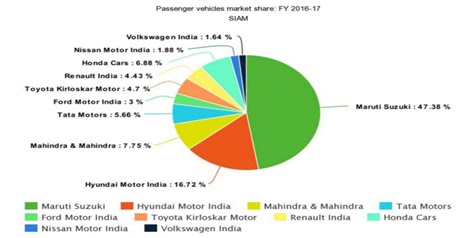
2. Extremely poor market share: GM India has sold around 25,823 cars in 2016-17 resulting into less than 1% market share in India. Market share break up as per SIAM is as below;
 

GM India is nowhere in the above chart which makes a strong case for shutting down the hugely unsuccessful venture in Indian market. Extremely small market share brings range of problems for any company but there is brighter side to this which will be discussed in part-2.
3. Inheritance of financial troubles of parent company & investors’ pressure: The Company (GM- USA) which was on verge of bankruptcy during 2008 crisis and bailed out by Government of USA by purchasing 61% equity stake worth of $50 Bil. has never come out truly  from financial troubles since then. Eventually government sold the stake from GM-USA with decent loss. When parent company does not have strong financial muscle, one can imagine how competitive the negotiations can be in the meeting rooms with Parent company when various country heads demanding higher budgetary allocation for their subsidiary. Indian subsidiary which has generated very low RoI (Returns on Investment) despite being present in such emerging market for more than two decades. This must have put future of GM India on radar of parent company. Lesser financial resource allocation to under-performing subsidiaries is logical decision, this financial crunch has also contributed towards decision of exiting Indian domestic market. Investors’ pressure has also generated enough heat as stock performance of GM has remained subdue. Two years back CEO Mary Barra has said that India is strategic market and will invest further & now GM India is exiting from Indian market this shows how much of investor pressure for better financial performance can lead to harsh and unwanted decisions.

4. Failure to understand Indian market & cut throat competition: Many experts have noted and highlighted the failure of certain automobile MNCs including GM India due to not being able to adopt the Indian culture and inability to understand unique requirement of Indian customers. In India many factors such as price, fuel efficiency, cost of ownership etc. play an important role unlike some of the developed markets. Interesting to observe that in such a huge Indian market Maruti Suzuki has near 50% market share while all other big MNC names such as Toyota, GM, Ford, Volkswagen etc. have managed very small fraction of the market share. One of the reasons is lack of small car portfolio (Most of the MNCs never had much of small cars in their portfolio as in other developed markets big cars are demanded more) which is most successful auto segment in Indian consumer market. Lack of consistent product and brand strategy has also played its’ role in denting the position of GM India. It started with Opel brands with Astra & Corsa, then around 2003 it introduced Chevrolet brand and later it has moved to Chinese models. Frequent launches and withdrawals of cars have led to shallow brand loyalty and very challenging new customer acquisition.